
17th century
Dahomey Emerges
The Kingdom of Dahomey develops around Abomey in present-day southern Benin.
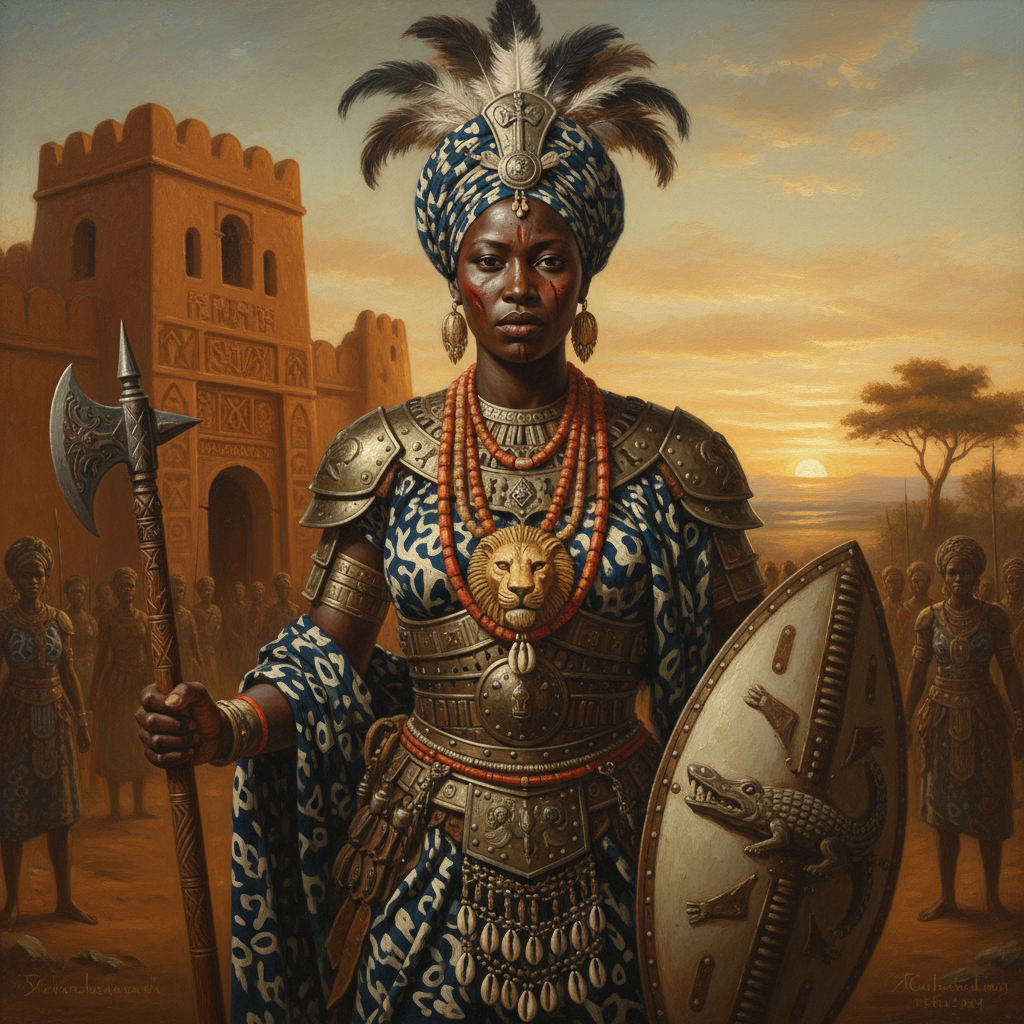
c. late 17th–early 18th century · West Africa
The Female Warrior King of Dahomey
A royal figure in the Kingdom of Dahomey remembered in oral traditions as a formidable woman ruler who defended the kingdom, shaped its military culture, and challenged the limits placed on women in power.
A royal successor
A woman who ruled
Military legacy
A contested history
Her story
Tassi Hangbe is remembered as one of the most compelling figures in the history of the Kingdom of Dahomey: a woman who stepped into royal power at a pivotal moment for the state.
According to Dahomean oral traditions, she was the twin sister of King Akaba and assumed authority after his death. Her reign is often placed around the turn of the eighteenth century, when Dahomey was consolidating power in the region around Abomey.
Because surviving written documentation is limited and later histories do not always agree, Tassi Hangbe’s story requires care. Yet the persistence of her memory speaks to a deep tradition of female authority and military leadership within Dahomean society.
Dahomey legacy
The Kingdom of Dahomey emerged in the seventeenth century in the region of present-day southern Benin. From its capital at Abomey, its rulers built a centralized state with a royal court, a disciplined military, and ceremonial institutions that shaped political life.
Royal succession was central to Dahomey’s stability. In oral accounts, Tassi Hangbe’s connection to King Akaba placed her at the heart of this political world, where kinship, ritual, and military authority were closely intertwined.
Her story belongs to a broader African history in which women could exercise influence as rulers, queen mothers, commanders, diplomats, and guardians of dynastic memory.
Dahomey legacy
Dahomean traditions describe Tassi Hangbe as taking on the responsibilities of rule after her brother’s death. Some accounts portray her as a ruler who presented herself in royal male attire and commanded the authority expected of a king.
The title “Female Warrior King” captures the force of that memory. It does not erase her identity as a woman; instead, it recognizes how she occupied a political role that later histories often reserved for men.
Her reign is sometimes described as brief, but its symbolic importance has endured. Tassi Hangbe’s story asks readers to look beyond official lists of rulers and consider how power can be preserved in oral tradition.
Dahomey legacy
Tassi Hangbe is frequently linked in oral tradition to the origins or early development of women’s military participation in Dahomey. Later generations would know the kingdom’s elite women soldiers as the Agojie.
The Agojie were not a legend or a decorative court feature. They were trained soldiers who served the Dahomean state, participated in campaigns, and became internationally recognized for their discipline and courage.
Historians debate the precise chronology of the Agojie’s formation, but Tassi Hangbe’s association with this tradition remains meaningful: it connects female rule with a wider culture of women’s public service and military strength.
Dahomey legacy
Tassi Hangbe’s life is not documented in the same way as many later rulers. Colonial archives and written royal histories often privileged male succession, while oral traditions carried other forms of knowledge across generations.
That does not make her story less important. It highlights why African oral histories, local custodians, and cultural memory are essential sources for understanding the past alongside written records and archaeology.
Today, Tassi Hangbe is remembered as a figure of courage and possibility. Her legacy continues to inspire conversations about women’s leadership, historical recovery, and the many ways African societies have imagined authority.
Key facts
Tassi Hangbe is remembered in Dahomean oral traditions as the twin sister and successor of King Akaba, who died in the early eighteenth century.
Her story preserves the memory of female political authority in a kingdom whose royal history was often recorded through male succession.
Traditions associate her reign with the development or strengthening of women’s military participation, later embodied by the Agojie—often called the Dahomey Amazons.
Written sources are limited and later accounts differ, so her life is best approached through both oral history and careful historical interpretation.
Her story belongs to the kingdom centered at Abomey in present-day Benin, a major West African state with a powerful court and military tradition.
Tassi Hangbe remains an important symbol of women’s leadership, courage, and historical memory in Benin and across the African diaspora.
Timeline
17th century
The Kingdom of Dahomey develops around Abomey in present-day southern Benin.
Late 17th century
King Akaba rules during a formative period in Dahomey’s early political history.
Early 18th century
Dahomean oral histories remember Tassi Hangbe as assuming royal authority after Akaba’s death.
18th–19th centuries
Dahomey’s women soldiers become a defining part of the kingdom’s military and ceremonial life.
19th century
The kingdom faces increasing pressure from French colonial forces in West Africa.
Today
Tassi Hangbe’s story continues to inform scholarship, cultural memory, and conversations about African women in power.
“Tassi Hangbe’s enduring place in Dahomean memory reminds us that African political history has always included women who ruled, commanded, and reshaped the future.”
Africa Origins
Continue exploring